Semiconductor Equipment Cleaning & Decontamination | BELFOR
Specialized Cleaning and Decontamination Certification for Semiconductor Equipment Relocation, Modification, and Disposal
Semiconductor manufacturing equipment and components may contain residual contaminants from process gases and chemicals. If these residues are not properly removed before equipment relocation, modification, or disposal, they can pose safety risks to workers and create complications during transportation and subsequent handling. Disposal costs are also a major consideration for companies dealing with contaminated semiconductor equipment. By removing hazardous residues through specialized cleaning, companies may be able to consider equipment reuse or sale as scrap metal, depending on the equipment’s condition and applicable requirements.
Why Does Semiconductor Equipment Require Specialized Cleaning?
Semiconductor manufacturing processes involve a wide range of gases and chemicals. Contaminants generated during these processes can remain not only on equipment surfaces but also inside piping and internal components. Some residues may become firmly embedded over time.
Conventional cleaning methods are often insufficient to remove these contaminants effectively. It is therefore essential to understand the equipment’s operating history, identify the characteristics of the contaminants, and select appropriate cleaning methods.
Before equipment is dismantled or transported off-site, potential risks associated with residual contamination must be assessed and appropriate safety measures implemented.
What Makes BELFOR’s Semiconductor Equipment Cleaning Different?
BELFOR determines the most appropriate cleaning method for each piece of semiconductor equipment based on the chemical properties of contaminants generated during manufacturing processes.
Using specialized cleaning agents developed at BELFOR’s R&D center in Germany, our experts carry out the cleaning process while considering both contaminant removal effectiveness and the potential risk of damage to equipment surfaces. Our semiconductor equipment cleaning process consists of eight stages.
BELFOR’s 8-Step Semiconductor Equipment Cleaning Process
- Residual Gas Measurement & Safety Inspection — Identify potential hazards inside the equipment before cleaning begins.
- Gas Purging — Remove residual gases from inside the equipment.
- Contaminant Removal & Component Disassembly — Assess contamination levels and disassemble components as needed.
- Contaminant Classification & Wastewater Treatment — Classify contaminants by type and determine appropriate cleaning and wastewater treatment methods.
- Alkaline Cleaning Solution Immersion — Apply a suitable immersion cleaning process to the affected components.
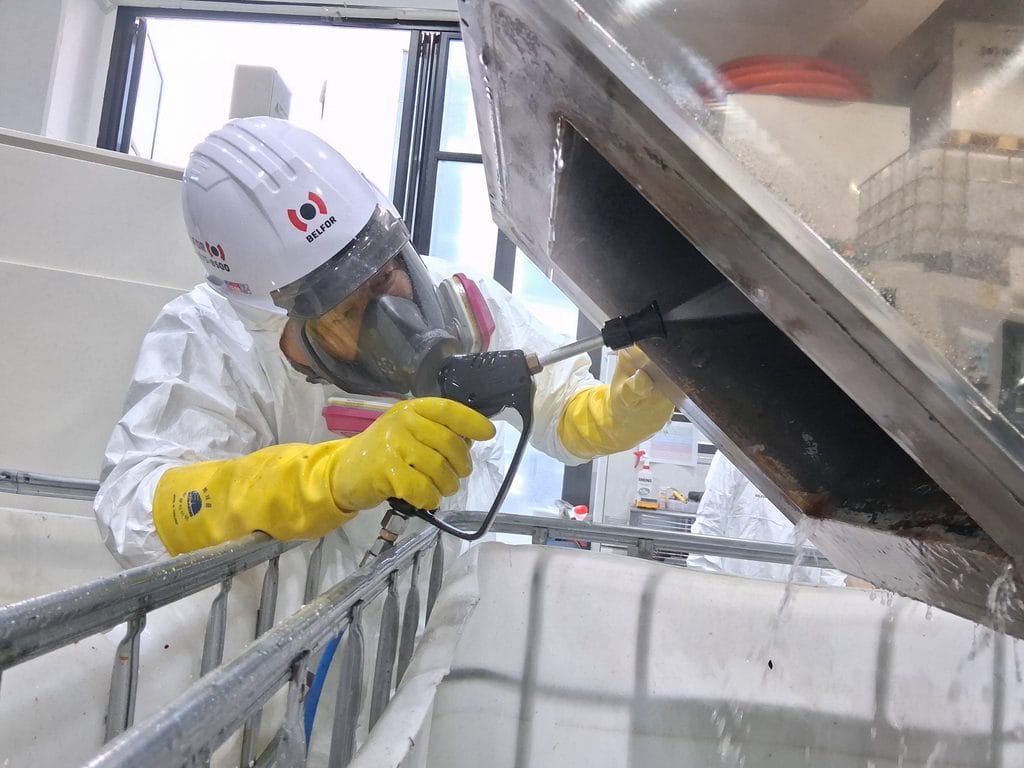
- High-Pressure Alkaline Cleaning — Remove stubborn, accumulated contaminants using a high-pressure alkaline cleaning process.
- Final Rinse with DI Water — Rinse away residual cleaning agents and contaminants using deionized water.
- Final Inspection, Reassembly & Certification — Verify the cleaning results, reassemble the equipment, and issue the relevant documentation.
The actual cleaning sequence and methods may vary depending on the equipment’s design, the type of contaminants, and site conditions.
Why Is a Decontamination Certificate Important?
Semiconductor equipment cleaning involves more than just removing contaminants. Verifying and documenting the cleaning results is equally important. BELFOR conducts appropriate tests, including pH, acidity, and powder residue measurements, depending on the equipment’s requirements, and issues a certificate documenting the results. This documentation helps verify the equipment’s decontamination status and supports decisions regarding its relocation, reuse, or disposal. For equipment and components scheduled for disposal, the level of decontamination can affect both the disposal method and associated costs. Components that would otherwise require specialized waste treatment may become eligible for recovery or sale as scrap metal after cleaning, provided they meet applicable requirements and the acceptance criteria of the receiving facility.
Final waste classification and disposal methods must be determined in accordance with applicable regulations and the condition of each piece of equipment.
What Types of Semiconductor Equipment Can Be Cleaned?
BELFOR has extensive experience providing specialized cleaning and decontamination services for a wide range of semiconductor manufacturing equipment and components at facilities in Korea and internationally.
Our cleaning services cover the following equipment categories:
- CMP and Deposition Equipment
- Diffusion and Thermal Processing (Furnace) Equipment
- Dry Etching (Plasma Etching) Equipment
- Ion Implantation Equipment
- Photolithography Equipment
- Wet Etching and Wafer Cleaning Equipment
- Metrology Equipment
- Wafer Back Grinding Equipment
- Atomic Layer Deposition (ALD) Equipment
BELFOR also has experience cleaning a wide range of semiconductor equipment and systems, including Gas Scrubbers, Producer SE, and MIR3000.
Before Disposing of Semiconductor Equipment, Explore Your Cleaning Options
If you are planning to relocate, modify, or dispose of semiconductor equipment, it is important to first assess any residual contamination and determine the scope of cleaning required.
BELFOR Korea assesses contamination levels in semiconductor equipment and components, providing comprehensive support from specialized cleaning and decontamination to final inspection and certification.
For expert guidance on safe equipment handling and cost-effective asset disposal, contact BELFOR Korea.