7 Things to Check When Choosing an Industrial Disaster Restoration Company
After a fire, flood, or contamination incident, choosing a restoration company involves much more than asking, “Can they clean it?”
Factories and industrial facilities contain not only buildings, but also high-value production machinery, mechanical systems, electrical and electronic equipment, and control systems.
Industrial disaster restoration does not end with removing visible soot or water. Immediately after an incident, further damage must be mitigated, the extent of contamination and damage to individual assets must be assessed, and decisions must be made about what can be restored, partially repaired, or replaced. Ultimately, the restoration process must support the safe restart of operations.
If you are selecting a restoration company after fire or water damage at a factory or industrial facility, these are the key capabilities to check.
Why does this matter?
In many industrial losses, production equipment can be more critical to business recovery than the building itself.
Even if the fire damage is cleaned and the building is ready for use, operations cannot return to normal if production machinery and electrical or electronic equipment remain out of service. High-value or custom-built equipment may also take months or longer to replace.
For this reason, the restoration feasibility of critical equipment should be assessed as early as possible after an incident.
Questions to ask the restoration company
● Can you restore machinery and production equipment as well as the building?
● Do you have experience with precision cleaning of electrical and electronic equipment and PCBs?
● Can you disassemble equipment and restore internal components?
● Can you support commissioning and return to operation after restoration?
How does BELFOR approach this?
BELFOR Korea assesses not only buildings affected by fire, water, or industrial contamination, but also machinery, production equipment, electrical and electronic systems, and precision equipment.
Rather than simply removing external contamination, BELFOR assesses the extent of damage and restoration feasibility. Where appropriate, precision cleaning and technical restoration are performed, followed by verification of the restored equipment.
What can happen on a real industrial site?
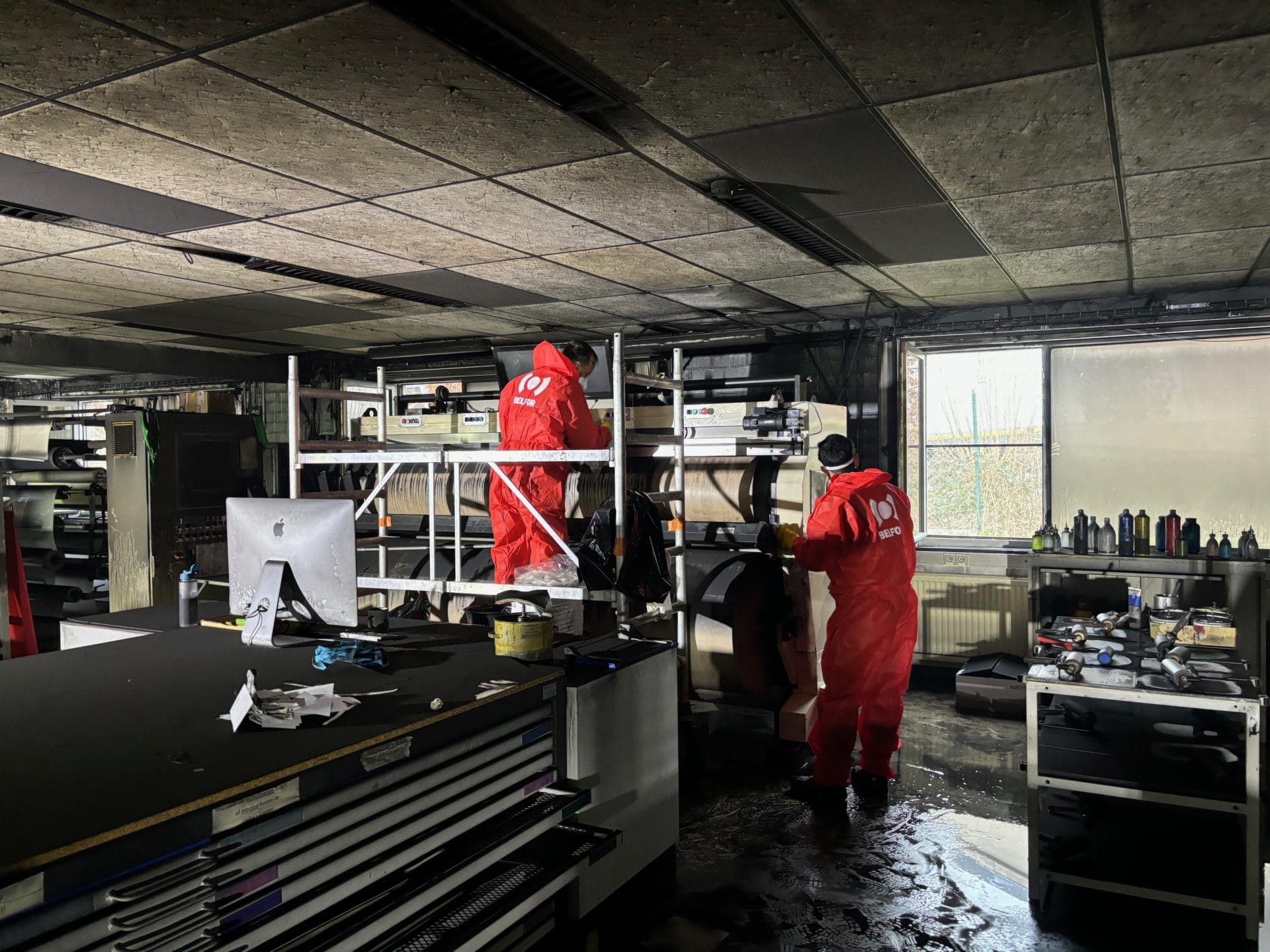
Visible soot inside a building may be removed relatively quickly, while critical electrical equipment such as MCC panels, inverters, and control systems remains contaminated and prevents the factory from restarting.
In such cases, developing one coordinated plan for both building and equipment restoration can help accelerate the return to operation.
Why does this matter?
The condition of industrial equipment cannot always be determined by visual inspection alone.
Equipment may appear clean while fire residues, ionic contamination, or moisture remain inside. Sensitive assets such as PCBs, control systems, and precision electronic components can be affected by even small amounts of contamination, potentially leading to long-term corrosion or malfunction.
The key question is therefore not simply whether equipment looks clean, but whether its condition can be supported bymeasurement and documentation.
Questions to ask the restoration company
● How do you assess contamination levels in equipment?
● Can you test for chlorides, ionic contamination, pH, or other relevant contaminants?
● Will you provide reports documenting conditions before and after restoration?
● Can the restoration history of individual assets be tracked?
How does BELFOR approach this?
BELFOR assesses the condition of the site and affected equipment to determine the extent of contamination and damage and, where required, measures chemical contamination.
For precision equipment restoration, BELFOR documents the pre-restoration condition, treatment methods, work performed, and post-restoration condition so that the restoration process can be tracked for individual assets.
What can happen on a real industrial site?
Two machines located in the same room may have very different contamination levels depending on their location, enclosure, and exposure to firefighting water.
Rather than classifying an entire facility as either “total loss” or “safe to use,” assessing assets individually can support a more practical and cost-effective restoration strategy.
Why does this matter?
Damage does not stop when the fire is extinguished or the floodwater is removed.
Soot, moisture, firefighting water, and extinguishing agents can continue to affect metals and electrical or electronic components after a fire. Following water damage, elevated humidity can accelerate corrosion and mold growth. Measures to limit secondary damage may therefore be required even before full restoration begins.
Questions to ask the restoration company
● What emergency measures can you take immediately after an incident?
● Can you help prevent corrosion and moisture-related damage?
● Can you contain contamination and prevent it from spreading?
● Can you conduct an emergency site assessment?
How does BELFOR approach this?
BELFOR’s restoration process begins with site assessment and loss mitigation.
After assessing the extent of damage, priority equipment and facilities at risk of further deterioration are stabilized. Depending on site conditions, measures may include dehumidification, drying, corrosion prevention, and contamination containment.
What can happen on a real industrial site?
If too much time is spent simply selecting a restoration contractor, metal components or electrical equipment that were initially restorable may deteriorate due to corrosion.
For major industrial losses, it is therefore important to determine whether a company can provide emergency assessment and loss mitigation even before the full restoration project begins.
Why does this matter?
Industrial facilities require different restoration methods from homes or general commercial properties.
Production machinery, control panels, PCBs, motors, and precision equipment may not be suitable for conventional wet cleaning or surface cleaning. Cleaning methods, chemicals, and drying processes must be selected according to the type of contamination and the materials involved.
Questions to ask the restoration company
● Do you have dedicated restoration processes for precision electronic equipment?
● Do you select different cleaning methods for different types of equipment?
● Can you provide ultrasonic cleaning or other precision cleaning methods?
How does BELFOR approach this?
BELFOR uses a range of restoration methods based on the characteristics of the affected assets, including precision equipment cleaning, ultrasonic cleaning, and specialized decontamination chemicals in addition to surface cleaning.
For sensitive electrical and electronic equipment, the appropriate method is selected according to the equipment characteristics and contamination conditions.
What can happen on a real industrial site?
The same cleaning method cannot be applied to structural steel, electrical panels, PCBs, and motors simply because they were affected by the same fire.
Some equipment may require a dry process, while other components may need to be removed and precision-cleaned separately. The important question is therefore not simply “Can they clean it?” but “Do they have the technology, equipment, and expertise to select the right restoration process for each asset?”
Why does this matter?
Not every piece of fire-damaged equipment needs to be discarded. At the same time, not every asset can or should be restored.
A component directly deformed by extreme heat is fundamentally different from one that has suffered contamination without significant physical damage.
A professional restoration company should therefore be able to objectively classify assets into three categories:
Restorable / Requires Partial Repair / Requires Replacement
Questions to ask the restoration company
● What criteria do you use to distinguish total-loss equipment from restorable equipment?
● Can individual modules be replaced while preserving the rest of the equipment?
● Can you provide documented reasons for your assessment of each asset?
● Do you also evaluate the economic feasibility of restoration?
How does BELFOR approach this?
During the damage assessment stage, BELFOR evaluates the technical restoration feasibility of equipment and facilities.
Physical heat damage is distinguished from contamination damage, and the scope of possible restoration, repair, and replacement is assessed to help customers determine an appropriate recovery strategy.
What can happen on a real industrial site?
A machine may be worth hundreds of millions of won, while only one critical module requires replacement and the remainder of the equipment can be reused.
Conversely, equipment may look relatively undamaged externally while a critical internal component has suffered direct heat damage, making replacement more appropriate than restoration.
The role of a restoration company is not to claim that everything can be restored, butto determine accurately what can realistically be saved.
Why does this matter?
Not all industrial fire losses present the same restoration challenges.
Battery manufacturing facilities may contain charge/discharge equipment and complex electrical and electronic control systems. Shipyards and marine facilities face additional risks involving salt contamination, humidity, and large-scale machinery. Power facilities require an understanding of critical assets such as switchgear, control panels, and generators.
For this reason, the total number of projects a company has completed may be less important than whether it has real restoration experience with facilities and assets similar to yours.
Questions to ask the restoration company
● Have you restored facilities in a similar industry?
● What types of equipment were affected?
● What restoration methods were used?
● Did the project continue through commissioning and return to operation?
How does BELFOR approach this?
BELFOR carries out disaster restoration projects across a wide range of industries, including manufacturing, power generation and distribution, marine and shipbuilding, and high-tech industries.
BELFOR Korea also provides restoration services following fire and water damage at industrial facilities in Korea, including machinery, electrical and electronic equipment, and buildings.
What should you look for in a real case study?
Rather than simply checking customer logos in a company profile, look for case studies that explain:
● What type of incident occurred?
● Which assets were damaged?
● What work did the restoration company actually perform?
● How long did the restoration take?
● How was the restored equipment verified?
These details make it easier to determine whether the company’s experience is relevant to your own facility.
Why does this matter?
A major industrial fire or flood restoration project rarely involves only one company.
Customers, insurers, loss adjusters, equipment manufacturers, construction contractors, and electrical and mechanical specialists may all be involved simultaneously.
When dozens or hundreds of machines are being restored, tracking the movement, disassembly, cleaning, reassembly, and testing status of each asset becomes a critical part of project management.
Questions to ask the restoration company
● Do you have experience managing large-scale industrial restoration projects?
● How do you track the work history of individual equipment and components?
● Do you provide before, during, and after photographs and condition records?
● Can you provide daily or weekly progress reports?
● Will you provide a final restoration report?
How does BELFOR approach this?
BELFOR organizes specialist resources according to the scale and requirements of each project and manages the restoration process by documenting work stages and equipment conditions.
For precision equipment projects, records can include asset identification, restoration activities, decontamination, reassembly, and testing. Following restoration, BELFOR works with the customer and relevant parties to verify the final condition of the restored assets.
What can happen on a real industrial site?
For a large-scale project, having a few highly skilled technicians is not enough.
The restoration company must be able to operate multiple teams simultaneously while maintaining consistent standards, tracking the status of individual assets, and clearly communicating progress and results to multiple stakeholders.
What Should You Look for When Choosing an Industrial Disaster Restoration Company?
The most important question is simple.
Not:
“Can this company clean our facility?”
But:
“Can this company manage everything required to get our facility and business back into operation?”
Before selecting an industrial disaster restoration company, consider these capabilities:
- Can it restore machinery, production equipment, and electrical and electronic systems as well as buildings?
- Can it measure and document contamination and damage?
- Can it minimize secondary damage immediately after an incident?
- Does it have specialized industrial restoration equipment and processes?
- Can it distinguish between restoration, partial repair, and replacement?
- Can it work with equipment manufacturers and support commissioning?
- Does it have relevant restoration experience with similar industries and equipment?
- Can it manage a large-scale site and document the restoration process?
A company that meets these requirements goes beyond being simply a fire cleaning company or an equipment repair contractor. It can serve as a specialized industrial disaster restoration partner, managing the broader recovery process required to return the business to normal operations.
BELFOR Korea
BELFOR Korea is a disaster restoration company specializing in the recovery of industrial facilities affected by fire, water damage, and industrial contamination.
BELFOR Korea provides restoration services for buildings, machinery and production equipment, electrical and electronic systems, and precision equipment.
From initial site assessment and loss mitigation to damage assessment, specialized restoration, decontamination, coordination with equipment manufacturers, and return-to-operation support, BELFOR Korea provides an integrated approach to helping industrial facilities recover and resume operations.