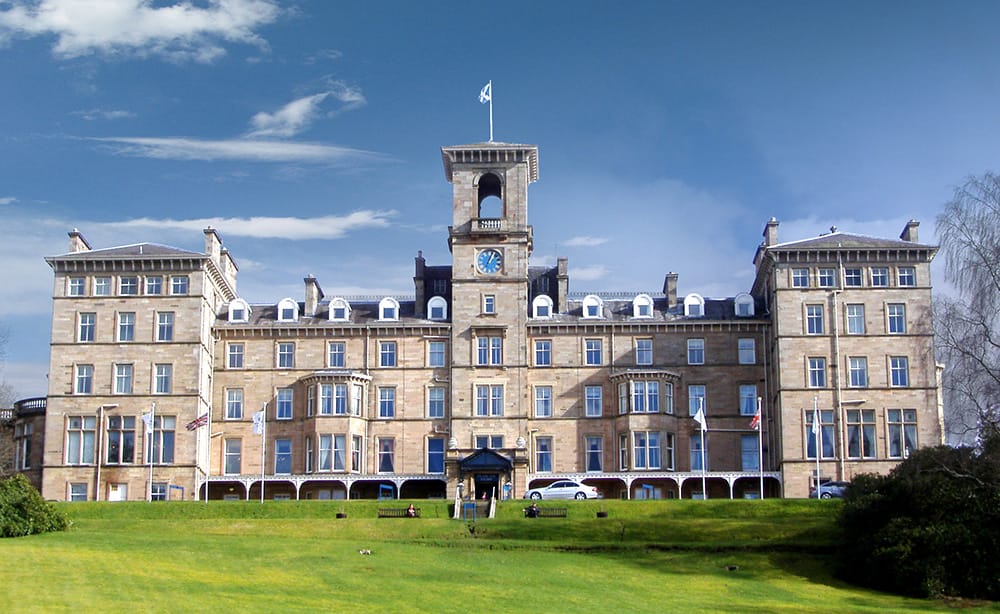
Restoration of the Hilton Dunblane Hydro Hotel
Case study from the archive · First published in 2004
What happened?
The idyll of a Victorian hotel in the Scottish Highlands was brought to a sudden halt on 5 February 2004 when fire broke out on the third floor and spread rapidly to the floor above. The day after the fire, the hotel contacted BELFOR UK as the Hilton Group is a RED ALERT® client.
This means that BELFOR are contracted to be at the scene within three hours of the initial phone call. The team were met by extensive fire and water damage: heavy contamination, a penetrating smell and thick deposits of soot and grime.
Restoration through the staff entrance
The water used to extinguish the fire had also left a trail of destruction. Since rooms were to be reopened for guests as quickly as possible, BELFOR UK had to work against the clock. The two damaged floors were closed to the public.
BELFOR staff were at work in several areas of the hotel in parallel.
Arrangements were made to remove and store a large quantity of furniture so that it could be cleaned off site by another team and returned as quickly as possible.
Please do not disturb
This was a complex restoration job requiring precise coordination and close cooperation with the hotel management, insurance companies and loss adjusters. Frequently, BELFOR had to use the staff entrance to the luxury hotel in order to minimise disruption and visibility to guests. Prompt action meant BELFOR UK’s experts soon had the prestigious hotel’s rooms and suites restored and returned to use.
Restoration work was urgently needed. But here is the conflict of interest: If the hotel were closed, the work could be completed quickly, yet a disruption of hotel operations was not in the interests of the owners, the insurers or the hotel guests. In particular, contracts with major clients would be jeopardised. What was to be done?
Restoration with an optical illusion
BELFOR’s brainwave: To prevent mould from spreading, the team created a containment structure that blended seamlessly with the existing décor—making the restoration invisible to guests and hotel operations continued undisturbed. However, BELFOR’s experts also had to deal with the unpredictable such as the advent of even more rain, triggering timing changes and a requirement for additional staff at various points. But despite all these challenges, the restoration timetable was maintained.
Hotel restoration is a particular type of structure and property restoration. It is important not to inconvenience guests but how can hotel operations carry on undisturbed while things are returned to normal? The measures taken in the first 24 hours after an incident are critical to all further action.
Notably in hotels, it is vital to contain the damage to the affected areas by the immediate measures taken: pumping out water, avoiding and promptly eliminating unpleasant odours and preventing mould formation. The aim is to minimise the scale of the damage and prevent long-term disruption to hotel operations.


